
Pharos Data · Infrastructure inspection
The fault, and the urgency.
A hot joint on a busbar or a cracked insulator gives warning before it fails. A Pharos station on site reads that warning on a schedule, and tells you how soon each finding needs attention.
The problem
Failures give warning. Most of it is missed.
Substation and line faults usually show as heat long before they trip. Inspections are periodic and manual, from the ground, and theft damage often goes unnoticed until something stops working. On rail and ports, the condition of long corridors is checked rarely and unevenly.
- Hot joints found only after they trip
- Theft damage found after the outage
- Periodic ground inspections that miss what is above eye level
- Long corridors checked rarely and unevenly
What we offer
What the station does for you.
A standard shot list per bay from safe standoff: bushings, breakers, arresters, busbar joints, cooling.
Cracked insulators, loose clamps, broken strands, nests and theft damage within reach of the station.
The sections a station reaches, flown along the servitude with every image tagged to chainage. Change against the last pass: dumping, encroachment, vegetation, fence breaks.
By night for theft, by day for condition.
What we look at
Component by component.
Each finding comes with a thermal image, a colour photo, a position and how soon it needs attention.
Busbar joints, clamps and terminals running hotter than the same part on the next phase.
Cracks, flashover marks and contamination, read with the telephoto camera from a safe standoff.
Uneven cooling and hot spots on transformers and radiators.
Towers, fences, vegetation and encroachment along the line, compared with the last pass.
What lands on your desk
One finding, as you receive it.
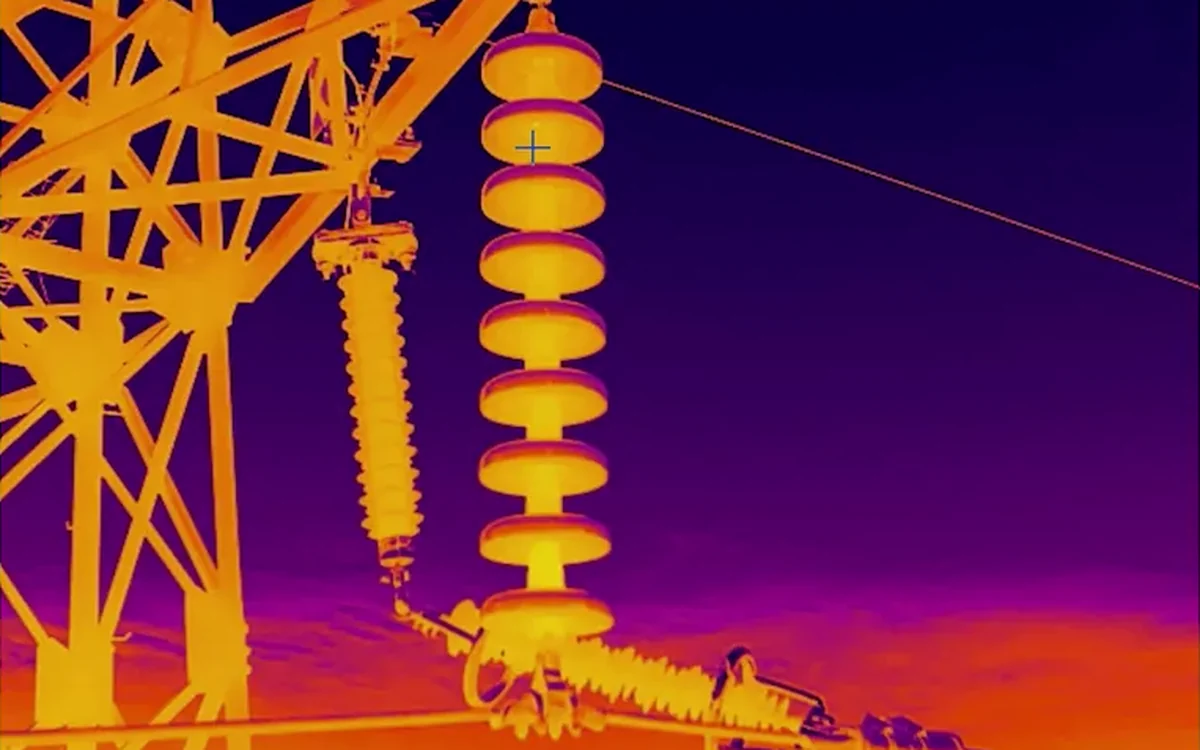
Substation 2 · Bay 04 · Insulator string
Hot joint, insulator string
Critical
Under 2 months
Every finding in your report carries the load and the weather logged at capture.
The aircraft
The Matrice 4TD, built for thermal.
The thermal and close inspection work is flown with DJI's Matrice 4TD, from the DJI Dock 3.
Radiometric, so every pixel carries a temperature.
Or ±2%, from −40 to 150 °C. Up to 500 °C in low gain, at ±5 °C or ±3%.
Three 48 MP cameras at 24, 70 and 168 mm, so small parts are read from a safe standoff.
Measures the distance to what the camera is looking at.
DJI's published specifications for the Matrice 4TD.
How we do it
How it works on your ground.
- 01A station on sitePlaced to reach the bays, spans or corridor sections you need watched.
- 02Like against likeHot joints reported against a similar component under similar load, with the load and weather logged at capture.
- 03Processed the same way every timeEvery capture goes through the same method, so findings compare pass to pass.
- 04Urgent findings called through liveAnything that cannot wait is called through while the aircraft is still up.
Built by Pharos
Our own software, working for you.
The aircraft and station are DJI hardware. What makes them one service is software we wrote ourselves. Here is what it does for you on this kind of site.
Our media pipeline checks, sorts and processes every capture as it comes off the aircraft. Each report is built with the same method as the last one, so month on month the numbers compare.
Our evidence chain seals every clip and every flight log the moment it is captured, with the pilot, station, time and position attached. If anything were changed afterwards, it would show.
Our bridge puts the live feed and the incident into the monitoring software your control room already uses. Your operators stay on their own screens and do not learn a new system.
What you get
What lands with you.
- A condition register with photos and positions
- A thermal findings report, each finding with how soon it needs attention
- Corridor patrol reports compared with the previous pass
- Urgent findings called through live
Questions
Infrastructure inspection, answered.
How close does the aircraft fly?
From a safe standoff, following a standard shot list per bay.
How do you judge a hot joint?
Against a similar component under similar load, with the load and weather logged when the image is taken.
Can the same station stop theft?
Yes. By night it patrols the same assets for theft, by day it checks their condition.
Do you cover a whole line?
The sections within reach of the station. The site assessment maps the exact coverage.
Book a site assessment
See what a station covers on your ground.
Outline your property on a satellite map and answer four questions, or leave your details. It costs you nothing and you are not committing to anything.